BlueCaster
Advanced Bluetooth Audio Transmitter for Windows, with full codec support.
Turns an ordinary Bluetooth adapter – a cheap USB dongle, or on many laptops the built-in one – from the basic codecs Windows gives it into a Hi-Fi transmitter: LHDC V5, LDAC and aptX Adaptive at up to 96 kHz (LHDC V5 up to 192 kHz), plus aptX HD, aptX, aptX Low Latency, Opus, AAC, SBC XQ, SBC and FastStream, and LE Audio (LC3). BlueCaster sets the adapter up by itself and gives it back to Windows with one click (how it works).
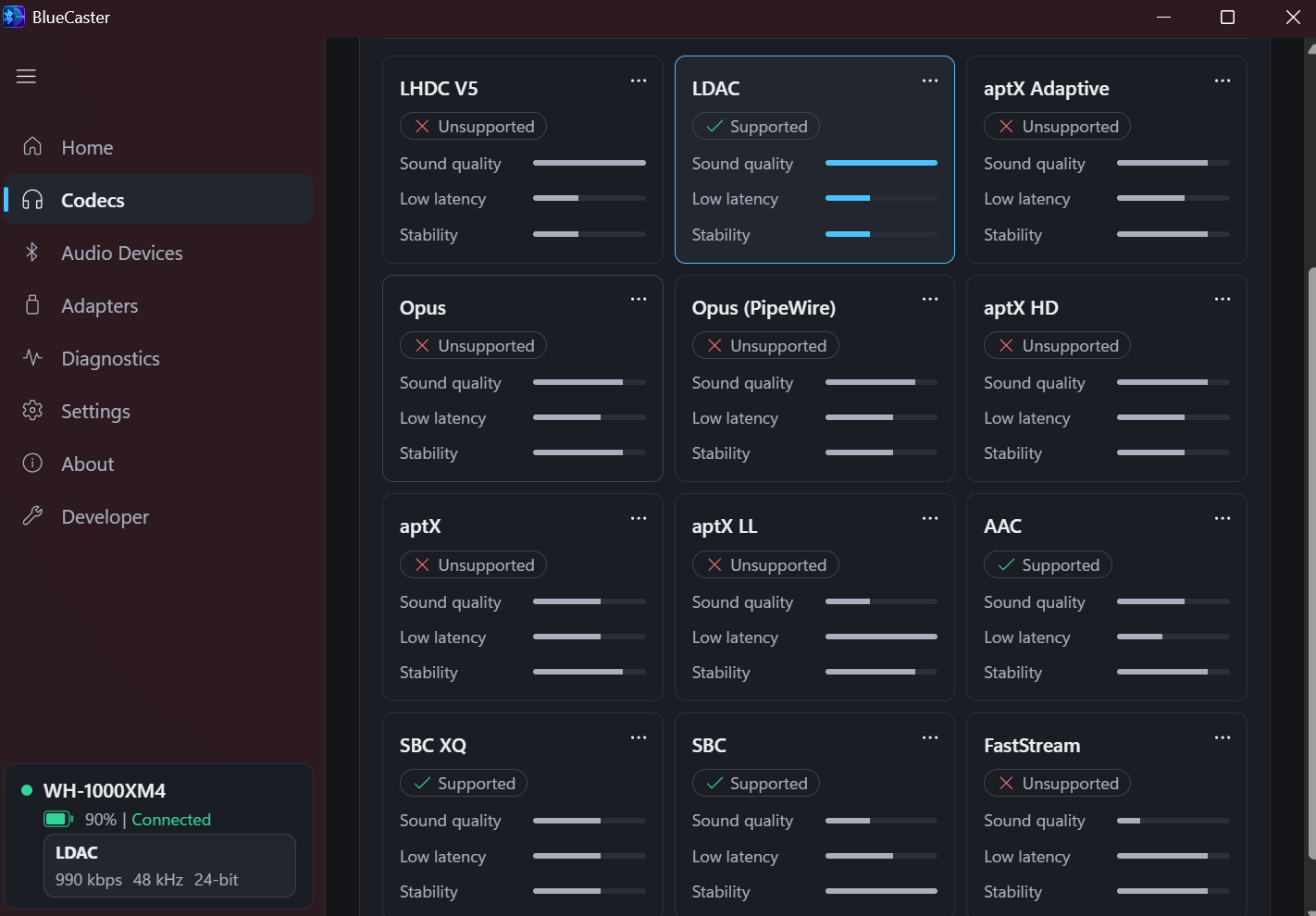
Supported Codecs
| Codec | Bitrate | Sample Rate | Bit Depth | Latency |
|---|---|---|---|---|
| LHDC V5 | 400/500/900/1000 kbps, ABR 160–400 kbps | 44.1/48/96/192 kHz | 16/24 bit | – |
| LDAC | 330/660/990 kbps | 44.1–96 kHz | 16/24/32 bit | ~200 ms |
| aptX Adaptive | 265/427 kbps (96 kHz: 646) | 48/96 kHz | 24 bit | – |
| Opus | 256 kbps | 48 kHz | 16 bit | – |
| aptX HD | 576 kbps | 44.1/48 kHz | 24 bit | ~150 ms |
| aptX | 352/384 kbps | 44.1/48 kHz | 16 bit | – |
| aptX Low Latency | 352 kbps | 44.1/48 kHz | 16 bit | ~32 ms |
| AAC | up to 256 kbps | 44.1/48 kHz | 16 bit | ~150 ms |
| SBC XQ | ~385/505/552 kbps | 44.1/48 kHz | 16 bit | ~150 ms |
| SBC | up to ~345 kbps | 44.1/48 kHz | 16 bit | ~150 ms |
| FastStream | 198/216 kbps | 44.1/48 kHz | 16 bit | – |
| Opus 05 | 256 kbps | 48 kHz | 16 bit | – |
| LC3 (LE Audio) | 32–124 kbps per channel | 16/24/32/48 kHz | 16 bit | ~140 ms |
| LC3 low latency (LE Audio GMAP) | 64–96 kbps per channel | 32/48 kHz | 16 bit | ~30 ms |
Codec Support by Platform (Sending to Headphones)
| Codec | Windows 10 built-in | Windows 11 built-in | Ubuntu built-in (PipeWire) | BlueCaster (Windows 10 / 11) |
|---|---|---|---|---|
| LHDC V5 | ❌ | ❌ | ❌ | ✅ |
| LDAC | ❌ | ❌ | ✅ | ✅ |
| aptX Adaptive | ❌ | ❌ | ❌ | ✅ |
| Opus (Android’s A2DP Opus) | ❌ | ❌ | ✅ PipeWire 1.2+ (opus_g); not in Ubuntu 24.04 (PipeWire 1.0.5) | ✅ |
| aptX HD | ❌ | ❌ | ✅ | ✅ |
| aptX | ✅ | ✅ | ✅ | ✅ |
| aptX Low Latency | ❌ | ❌ | ✅ | ✅ |
| AAC | ❌ | ✅ | ❌ not in Ubuntu’s packages | ✅ |
| SBC XQ | ❌ | ❌ | ✅ | ✅ (sinks whose SBC allows dual channel, bitpool ≥ 29) |
| SBC | ✅ | ✅ | ✅ | ✅ |
| FastStream | ❌ | ❌ | ✅ | ✅ (music only, chosen explicitly) |
| Opus 05 (PipeWire’s own Opus) | ❌ | ❌ | ✅ PipeWire 0.3.57+ (opus_05, to PipeWire devices only) | ✅ (chosen explicitly, developer mode only) |
| LC3 (LE Audio, BAP unicast) | ❌ | ✅ on PCs whose Bluetooth hardware and driver support LE Audio | ✅ PipeWire BAP lc3 (BlueZ LE Audio) | ✅ (a device’s LE Audio entry; GMAP low latency with gaming headsets; Bluetooth 5.2 adapter with ISO, Usage) |
✅ supported · ❌ not supported. All columns are the sending side (PC → headphones). “Built-in” is the OS’s own Bluetooth audio, without BlueCaster; the Ubuntu column is the PipeWire codec set of Ubuntu 26.04 (libspa-0.2-bluetooth).
aptX HD and aptX Low Latency follow the Android / PipeWire implementations and pass encode/decode round-trip tests, but have not yet been verified with real headphones. Latency values in this table are typical figures, not measured with BlueCaster.
About LHDC V5. It uses a C port of the LHDC V5 encoder that Google added to Android 17 (AOSP, Apache-2.0); the port was verified bit-exact against the AOSP Rust encoder, and the A2DP signaling follows Android’s a2dp_vendor_lhdcv5. A user verified it with real LHDC V5 headphones at 1000 kbps / 192 kHz on v1.1.1-beta.1 (#50); v2 uses the same encoder. Only lossy LHDC V5 is supported: LHDC V2/V3 (older headphones) and the lossless “LHDC-RAW” mode have no open-source encoder. In Auto mode LHDC V5 ranks first, above LDAC.
Opus is Android’s A2DP Opus vendor codec (Android 13+, vendor ID 0x000000E0 Google): 48 kHz, 20 ms frames, 256 kbps stereo as Android requests it (Standard 192, Mobile 128 kbps), encoded with libopus 1.5.2. It passes the end-to-end test against a virtual sink, but has not yet been verified with real Opus headphones. In Auto mode it ranks below aptX Adaptive and above aptX HD.
Opus 05 is PipeWire’s own A2DP Opus vendor codec (vendor ID 0x000005F1, codec 0x1005; PipeWire opus_05), which only PipeWire implements, so the receiver has to be a PC running PipeWire as an A2DP sink. BlueCaster sends the stereo music direction only (no 5.1 / 7.1, no return channel): 48 kHz, 10 ms frames (20 ms if the sink has only that), the same libopus encoder and bit rates as Opus, capped at the sink’s limit. Auto never picks it; choose it on Codecs or with -c opus05. It passes the end-to-end test against a virtual sink that offers PipeWire’s capabilities, but has not been tried with a real PipeWire receiver. PipeWire as an A2DP sink decodes Opus 05 since 0.3.57 and Android’s Opus (opus_g) since 1.2.0: Ubuntu 24.04 LTS ships PipeWire 1.0.5 (Opus 05 only), Ubuntu 25.10 (1.4.7) and 26.04 LTS (1.6.2) ship both; neither is verified with BlueCaster yet.
SBC XQ was verified with a Sony WH-1000XM4 (dual channel, bitpool 43 at 48 kHz, 552 kbps). Sinks that refuse the configuration are reconnected with plain SBC. FastStream passes the end-to-end test against a virtual sink but has not been tried with real FastStream headphones. Music direction only; Auto never picks it.
Only need classic aptX? Windows 10 already supports classic aptX in its built-in Bluetooth stack (not aptX HD, aptX LL or aptX Adaptive), so BlueCaster is not required for it. BlueCaster is mainly useful for LHDC V5, LDAC, aptX Adaptive, aptX HD and aptX Low Latency.
About aptX Adaptive. It is encoded with the MIT-licensed pure-Rust encoder of AKS-Logic/aptx-adaptive-linux, whose tables its authors reconstructed from shipped Qualcomm binaries and on-air captures. 48 kHz stereo (44.1 kHz requests are captured at 48 kHz), 24-bit: High 427 kbps or Low Latency 265 kbps (R2 sinks: 270), ABR in High. 96 kHz (High, 646 kbps) is used when you choose it in its settings, if the headphones are an R2 sink that lists 96 kHz, and never in Low Latency; Auto streams 48 kHz. Auto picks it after LHDC V5 and LDAC; or choose it on Codecs or with -c aptxad. A user confirmed it on an EarFun Air Pro 4+ at 48 kHz on 2.0.2-beta.6, as stable as classic aptX, and 96 kHz on real headphones since (#86); upstream reports it working on Linux with Bose QuietComfort Ultra (gen 1) and B&W Px7 S2e. See aptX Family and aptX Adaptive.
Platform Support
| Component | Windows 10 (x64 / ARM64) | Windows 11 (x64 / ARM64) | Linux (Ubuntu) |
|---|---|---|---|
| BlueCaster (window, tray, CLI) | ✅ (not yet tried on real hardware) | ✅ | ❌ |
| Building from source (Rust, Visual Studio 2022+, Node.js) | ✅ | ✅ | ❌ |
bluecaster_decode (stream checker) | ✅ | ✅ | ❌ |
End-to-end test tools/emu/run_test.py | ✅ | ✅ | ❌ |
Virtual adapter tools/emu/emu_vhci.py | ❌ | ❌ | ✅ |
Measuring receiver tools/linux_sink | ❌ | ❌ | ✅ |
BlueCaster itself runs on Windows only (Windows 10 22H2 or Windows 11), built for x64 and ARM64. The Linux tools need Python 3.11 or later (verified on Ubuntu 26.04); setup.sh targets Ubuntu / Debian, other distributions need the packages installed by hand.
Verified Hardware
Tested with Sony WH-1000XM4 and WH-1000XM6, EarFun Air Pro 4+, Grado GW100x and more, on TP-Link UB500, generic RTL8761B, a laptop’s built-in RTL8852BE, ASUS BT400 and CSR8510 adapters. The full list with codecs, versions and the reports behind it: Verified Hardware.
Dropouts and Connection Problems
What the dropout and connection reports turned out to be, the checks to run before reporting, and how to read Link Quality: Dropouts and Connection Problems.
Works With
Third-party apps that work together with BlueCaster, such as earbud control apps, as reported in the issues (not made or supported by BlueCaster): Works With.
Audio Capture Modes
BlueCaster captures audio via WASAPI and offers three modes:
| Mode | Description | Use Case |
|---|---|---|
| Default device | Captures all system audio output from the default playback device | Simple setup – all sounds are streamed |
| Virtual Device | Captures from a user-selected virtual audio device (e.g., VB-CABLE, VoiceMeeter) | Route specific apps to Bluetooth while keeping other audio on speakers |
| Application | Captures only what one app plays, after its own processing (Windows 11 / Windows 10 2004+) | Send one app, or the output of a system-wide effects app (equalizer, sound enhancer) |
In Virtual Device mode, BlueCaster can switch the Windows default playback device to the selected virtual device (Set as Windows default output while connected), then captures its loopback output. Apps that output to the virtual device are streamed over Bluetooth. When streaming stops, the previous default device is restored.
The Default device source does not take the audio away from the default playback device: it plays there as well as over Bluetooth. If the selected virtual device cannot be opened, the connection sends the system audio instead and says so. See Capture Modes.
How It Works
---
config:
  flowchart:
    wrappingWidth: 480
    rankSpacing: 30
---
flowchart TD
    s1["System loopback"]
    s2["Virtual device"]
    s3["Application (process loopback)"]
    s1 & s2 & s3 --> cap["WASAPI loopback capture (PCM)"]
    cap --> enc["Audio encoder:<br>LDAC / aptX family / LHDC V5 / Opus / AAC / SBC"]
    enc --> bt["BTstack: A2DP Source → AVDTP → L2CAP → HCI"]
    bt --> usb["WinUSB → USB Bluetooth adapter"]
    usb -.-> hp["Headphones"]
BlueCaster bypasses the Windows Bluetooth stack entirely. It communicates directly with a USB Bluetooth adapter through WinUSB, using BTstack to implement the full Bluetooth protocol stack in user-mode. A small resident program (bluecaster-core.exe, with the tray icon) streams the audio; the window only shows its state, so closing it does not stop the audio (see Architecture).
Features
- Multi-codec: LHDC V5, LDAC, aptX Adaptive, aptX, AAC, aptX HD, aptX Low Latency, Opus, Opus 05, FastStream, SBC XQ and SBC with automatic negotiation
- LE Audio: LC3 to LE Audio headphones and earbuds (BAP unicast, both earbuds of a pair, headset volume, media buttons, GMAP low latency). Needs an adapter with Bluetooth 5.2 isochronous channels; tested on a MediaTek MT7925 and against the Bluetooth emulator so far (Usage)
- Three capture modes: System loopback, virtual audio device routing, or one application’s output
- Window, tray and CLI: a window for setup and diagnostics, a tray flyout and menu for everyday connecting, and a command line (see Usage)
- WinUSB in the app: assigns the WinUSB driver to the adapter and restores the original driver, no Zadig needed (see Setup); headphones Windows paired through the adapter connect without pairing again
- First-run setup: adapter, driver and firmware, headphones, a first connection, general settings
- ABR: Adaptive Bit Rate for unstable connections (LDAC, LHDC V5 and aptX Adaptive; adaptive bitpool for SBC and SBC XQ)
- Auto-reconnect: Reconnects after a lost link (3 attempts; 10 when the adapter has to start again) and after the PC resumes from sleep; Reconnect automatically on Audio Devices turns it off
- Link quality and AFH: Shows what is sent, the RSSI and the channels in use; tells the adapter which Wi-Fi channels to avoid (see Usage)
- Headphone controls (AVRCP): Volume slider synced with the headphones and the Windows volume; their play/pause, next and previous buttons control playback on the PC (see Usage)
- Per-device settings: a codec (with its own settings) and an output source for each audio device, side by side on Home and connectable from the tray
- Updates: The installed version updates itself after the audio device disconnects (see Usage)
- Localization: English, Japanese, Simplified / Traditional Chinese, Korean, German, French and Spanish
- Realtek firmware: Guided firmware download for Realtek adapters
- Diagnostics: connection flow, log, HCI capture, diagnostics for bug reports, peer receiver test against a Linux PC (see Usage)